You want to start a mentoring program, and sooner or later someone will ask what it costs. The honest first answer is that the price depends less on the vendor than on which part of the problem you're paying someone else to solve.
I've worked in HR at startups, and at the small to mid size the questions usually arrive in this order. Do we have the mentors? Who is going to run it? Can I sign for it without a finance conversation? The price only makes sense once those three have an answer.
Start with what you're actually buying
A mentoring program has three moving parts: the people who mentor, the matching, and the running of it week to week. Every option on the market takes some of those off your hands and leaves the rest with you. That split is what the price reflects.
If you have enough experienced people inside and someone with time to coordinate, you're buying a tool. If you don't have the mentors, you're buying people. If you have a few people willing to mentor but nobody with the hours to run a program, you're buying the running of it.
If you have the mentors: software
Mentoring software handles matching, scheduling and reporting for a program you run inside your company. Most vendors only quote after a demo. Among the ones that publish a price, Mentorloop Pro starts at $299 a month, Mentorgain at $4,000 a year, and MentorcliQ's entry package at $9,900 a year for 100 employees, according to FirstHR's comparison of ten platforms from October 2026.
Two things catch smaller companies out. The entry tiers are sized for 50 to 100 users, so with fifteen participants you pay for a band you won't fill. And the software doesn't run anything. Someone still recruits mentors, chases the pairs that stopped meeting and writes the report at the end. In a two-person HR team, that someone is you.
Below roughly twenty participants, a spreadsheet and a good conversation guide cover most of what the software does, as long as someone has the hours to keep it going.
If you don't have the mentors: paying per person
The other route is buying mentors from outside, one employee at a time. On MentorCruise, career coaches list monthly plans from $70 to $900, with a median of $270. Three people for three months at the median comes to about $2,400.
It's easy to approve and it works well for one person with a specific goal. As a program it gets expensive quickly, and nothing connects the relationships, so the company learns very little about what its people actually needed.
If you have a few mentors but no time to run it: a managed program across companies
Managed cross-company programs pair your people with mentors from other organisations and run the whole thing for you. It's the model I built PeopleTopics on, for startups of 50 to 300 people.
Each cohort runs for three months. Companies pay €290 per cohort, which covers up to three mentoring pairs, each meeting for three sessions. Every pair beyond three adds €50.
It can cost that little because companies exchange mentors. Each company sends mentees and also lends mentors, so the cohort supplies its own. The matching, the session guides and the feedback after every call are built by us and shared across all the companies in it.
So what you bring is the mentors, and that's it. You don't need a full bench of them, just a few experienced people willing to give some sessions. What you don't bring is the hours to run it. Matching, scheduling, reminders, the feedback after every call and the report at the end are handled for you. HR's part is approving the pairs.
What's said in a session stays between the pair. HR sees aggregated feedback for the company, never the conversations.
A worked example: 50 people, five pairs
Say you run HR at a 50-person company and want five people mentored this quarter, each pair meeting three times for an hour.
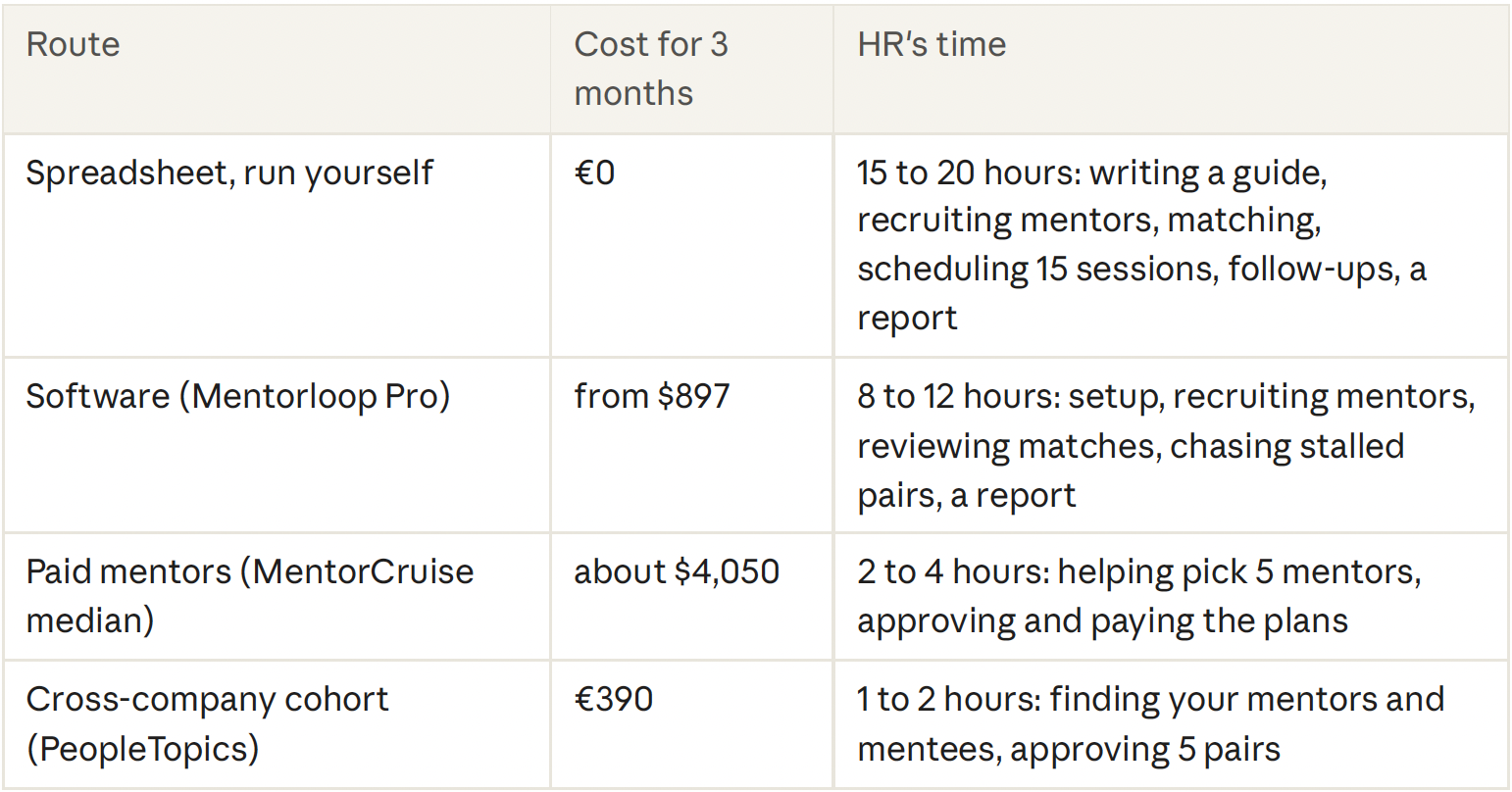
Prices in the currency each vendor publishes. HR hours are estimates for a first round over three months. Mentorloop's first tier covers 50 users, so at this size you'd fill it exactly.
The spreadsheet wins on money and loses on your calendar. Paid mentors win on your calendar and cost roughly ten times as much. The cohort is the only line that's low on both, and the trade is the 15 hours your own mentors give to other companies' people.
Don't forget to budget time
Whichever route you choose, the biggest line in the budget is your people's time. Five pairs meeting three times is 15 hours from your mentees and, unless you buy outside mentors, 15 from your mentors, spread over a quarter. A program survives when people feel those hours were worth giving.
In a cross-company program, the hours come back to you. Your mentors spend them with someone from another company, which is leadership and coaching practice. They hear how other teams handle the problems yours is stuck on, and they bring fresh perspectives back. Your mentees get an hour with someone outside their reporting line, and they can test ideas there before trying them at work.
Where to start
If you're putting together a first budget, work through the three questions from the top in that order: count the people who would actually mentor, decide who runs matching and scheduling, and only then compare prices. That order is what catches the costs nobody budgets for, like the coordinator who doesn't exist or the pairs that quietly stop meeting in month two.
If your answer to the second question is nobody, here's how a PeopleTopics cohort works and what it would ask of your team.